



Fleet operators across India are bleeding money every single day. Fuel theft, inaccurate consumption tracking, and zero visibility into what’s happening inside a vehicle’s tank are eating into profits that are already squeezed by rising diesel prices, GST pressures, and growing competition in the logistics sector. If you manage a commercial fleet in India, you know this pain intimately. Your trucks are somewhere on the highway, your fuel bills are climbing every month, and your data tells you almost nothing useful. That disconnect between operational reality and what your reports show is costing you more than you think.
Here’s the thing. A high-quality fuel-level sensor device eliminates that disconnect entirely. It gives you the kind of precise, real-time visibility that transforms fuel from an unmanageable cost into a fully controlled resource. Today, two sensor technologies dominate the Indian commercial fleet market: capacitive sensors and ultrasonic sensors. Both measure fuel levels. Both feed into modern fuel monitoring systems. But they work on completely different principles, perform differently under Indian road and climate conditions, and suit different types of fleet operations.
Everything you need to know is broken down in this article. You’ll understand how each sensor works, how they perform under Indian operating conditions, how they integrate with telematics platforms, and which one is the right fit for your fleet. Keep reading. This decision will directly impact your operational costs.
Introduction to Fuel-Level Sensor Devices in Fleet Monitoring
A precision instrument mounted in or on a vehicle’s fuel tank is called a fuel-level sensor device. Its job is straightforward but critically important. It continuously measures how much fuel is present inside the tank and transmits that data to a centralized monitoring platform in real time. For Indian fleet operators managing dozens or hundreds of vehicles spread across vast distances, this capability is nothing short of essential.
India’s commercial vehicle fleet is one of the largest in the world, with over 5 million registered trucks and commercial transport vehicles actively operating on Indian roads as of recent estimates by the Ministry of Road Transport and Highways. Managing fuel across even a fraction of that fleet without automated sensor-based monitoring is an exercise in financial recklessness.
Modern IoT fuel sensor devices capture fuel data continuously, convert it into digital signals, and push that information to cloud-based dashboards through cellular networks. Fleet operators can then monitor fuel levels across their entire vehicle pool from a single screen, track refuelling events, set consumption benchmarks per route, and receive instant alerts when something abnormal occurs.
The Petroleum Planning and Analysis Cell (PPAC) under the Ministry of Petroleum and Natural Gas reports that diesel accounts for nearly 40% of total petroleum product consumption in India, and the majority of that consumption happens in the road transport sector. With High-Speed Diesel (HSD) prices fluctuating significantly across Indian states due to state-level VAT variations, every litre of fuel that goes unaccounted for represents a direct and compounding financial loss. A reliable real-time fuel monitoring system is the first line of defence against that loss.
Role of Fuel Monitoring in Telematics-Driven Fleet Operations
India’s fleet management industry has undergone a significant transformation over the past decade. The government’s push for digital infrastructure, the rollout of the Fastag system, and the mandatory fitment of AIS-140 compliant Vehicle Location Tracking (VLT) devices across commercial vehicles have collectively created a foundation for data-driven fleet operations. Fuel monitoring is now a natural extension of this digital infrastructure.
A fuel monitoring system doesn’t operate as a standalone tool. In a properly integrated telematics setup, fuel telemetry data flows continuously into the same platform that handles GPS tracking, driver behaviour scoring, route optimization, and maintenance scheduling. Every data stream reinforces the others. A driver who deviates from an assigned route without authorisation creates a fuel consumption anomaly that the system flags automatically because both the GPS deviation and the unexpected fuel drop appear together in the same timeline.
The Society of Indian Automobile Manufacturers (SIAM) has consistently highlighted fuel efficiency as a top operational priority for Indian commercial vehicle operators. Studies within the Indian logistics sector indicate that fuel typically constitutes 28% to 35% of total operational costs for truck fleet operators, depending on route profiles and vehicle load factors. For a mid-sized fleet running 50 trucks, a 10% improvement in fleet fuel efficiency tracking through better monitoring and behavioural corrections can result in annual savings of ₹50 lakh to ₹1 crore, depending on average daily mileage and diesel prices at the time.
Vehicle telematics fuel tracking integrates with driver monitoring systems to evaluate idling behaviour, aggressive acceleration patterns, and unnecessary engine running during loading and unloading stops. These behavioural patterns have an enormous cumulative impact on fuel consumption across large Indian fleets operating on national highways, state roads, and urban delivery routes simultaneously.
Working Principle of Capacitive Fuel-Level Sensor Devices
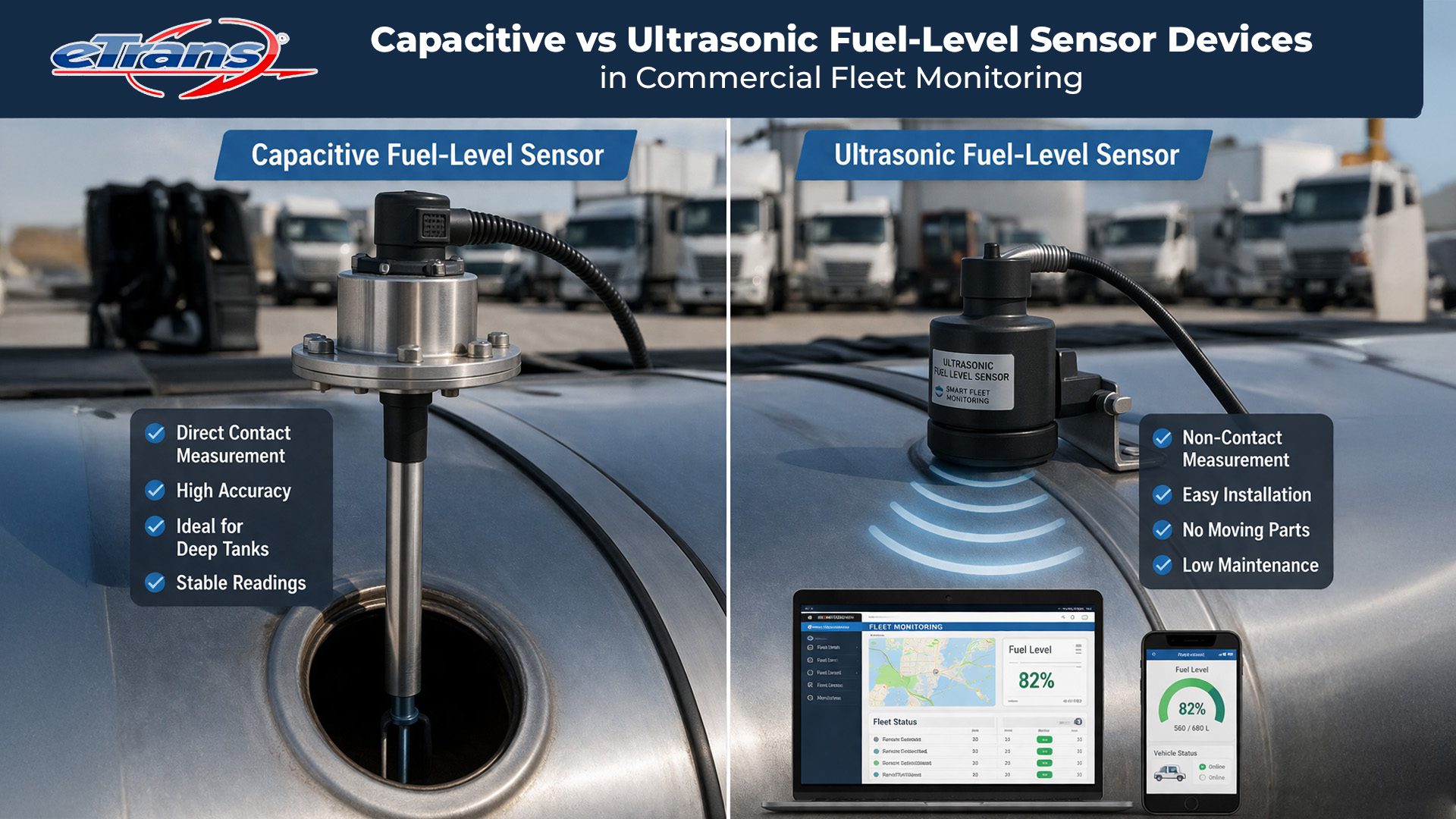
Capacitive fuel probe technology is based on a fundamental principle of electrical physics. Every material has a measurable dielectric constant, which describes how that material interacts with an electric field. Diesel fuel has a dielectric constant of approximately 2.0 to 2.2, while air has a dielectric constant of 1.0. This difference is the foundation on which capacitive sensors operate.
A capacitive probe consists of two concentric cylindrical electrodes that form a capacitor. The capacitance of this system changes depending on what medium surrounds the electrodes. As fuel rises or falls around the probe, the ratio of fuel to air in contact with the electrodes changes. That change in capacitance is measured by precise electronic circuitry and converted into a fuel level reading with extremely high resolution.
What makes capacitive fuel probe technology particularly well-suited to the Indian fleet market is its ability to detect very small changes in fuel volume. High-quality capacitive probes achieve resolutions as fine as 0.1% of total tank capacity. For a 400- liter tank commonly found on Indian long-haul trucks, that’s a 0.4-liter resolution. This level of precision is critical in a country where fuel adulteration and incremental siphoning are documented and widespread problems.
Indian trucking operations also deal with significant temperature variation across geographic zones, from the extreme heat of Rajasthan and Gujarat to the cold conditions of Himachal Pradesh and the Northeast. Capacitive sensors are factory-calibrated to account for temperature-related changes in fuel density and dielectric properties, maintaining accuracy across a wide operating temperature range. This makes them highly reliable for diesel tank level monitoring across India’s climatically diverse operating environments.
Working Principle of Ultrasonic Fuel-Level Sensor Devices
An ultrasonic tank level sensor takes a completely different approach to measuring fuel.Instead of immersing electrodes into the fuel, it works entirely through sound. The sensor emits focused ultrasonic pulses at frequencies typically above 20 kHz, directed toward the fuel surface inside the tank. These pulses travel through the air space above the fuel, reflect off the fuel surface, and return to the sensor as an echo. By precisely measuring the time taken for the echo to return, the sensor calculates the distance from the sensor to the fuel surface. Combined with known tank geometry, this distance calculation gives an accurate fuel level reading.
The fundamental appeal of an ultrasonic tank level sensor is that it never comes into contact with the fuel. The sensor sits outside the tank, and the measurement happens entirely through acoustic wave propagation. This non-contact approach makes the sensor immune to chemical degradation from fuel contact, eliminates any risk of fuel contamination through sensor installation gaps, and simplifies the overall deployment process considerably.
For India’s remote fuel monitoring system market, ultrasonic sensors offer a particularly compelling advantage. Fleets operating in remote areas, smaller logistics companies with limited technical staff, and transport contractors who lease vehicles rather than own them can deploy ultrasonic sensors quickly without specialized tank modification. The sensor simply mounts externally with adhesive or mechanical brackets, connects to the telematics unit, and is calibrated through software. The entire process can be completed without removing the vehicle from service for extended periods.
Modern ultrasonic sensors designed for Indian market conditions incorporate temperature compensation algorithms because the speed of sound in air changes with temperature, approximately 0.6 meters per second per degree Celsius. Without compensation, temperature swings of 30°C to 40°C common in Indian climates would introduce measurement errors. Quality sensors account for this automatically, maintaining consistent accuracy across seasons.
Installation and Deployment Considerations in Fleet Vehicles
Installation practicality is a massively underrated factor in fleet sensor selection, especially in the Indian context. India has a highly fragmented fleet ownership structure. According to the All India Motor Transport Congress (AIMTC), approximately 75% of India’s truck fleet is owned by small operators running five or fewer vehicles. These operators typically don’t have in-house technical teams, and every hour a vehicle spends off the road for installation directly reduces revenue.
Capacitive sensors require insertion into the fuel tank. The standard installation involves drilling a mounting hole of appropriate diameter into the top of the tank, inserting the probe rod to the correct depth (which must match the tank’s interior height precisely), and sealing the installation with a fuel-resistant gasket and mounting flange. This process requires a trained technician, takes approximately 2 to 4 hours per vehicle, and creates a permanent modification to the tank. For fleet operators running TATA Prima, Ashok Leyland Commander, or BharatBenz heavy-duty trucks with large under-chassis tanks, proper installation access can add further complexity.
Ultrasonic sensors flip this equation entirely. External mounting means no drilling, no tank modification, and no fuel system interference. A qualified installer can complete the entire process in 20 to 45 minutes per vehicle, including mounting, wiring to the telematics device, and initial software calibration. For a large Indian fleet operator needing to equip 200 vehicles rapidly, this speed difference is the difference between a three-week project and a six-month one.
However, Indian road conditions introduce a specific challenge for externally mounted ultrasonic sensors. Indian highways, state roads, and rural kutcha roads expose the undercarriage of commercial vehicles to significant impact from potholes, speed breakers, road debris, and uneven surfaces. External sensor mounting must incorporate robust physical protection to prevent damage from these hazards. Properly protected and mounted, ultrasonic sensors perform reliably, but the protection requirement adds
to installation cost and must be factored into deployment planning for GPS fuel sensor integration projects.
Measurement Accuracy and Data Precision in Fleet Monitoring
Data accuracy is the backbone of every smart fleet fuel management decision. If your sensor readings are unreliable, your entire operational intelligence structure collapses. This is not a theoretical concern in India. Fuel adulteration, incremental siphoning at dhabas and roadside stops, and deliberate odometer tampering are documented challenges that make precise sensor data genuinely critical.
The Bureau of Indian Standards (BIS) and the Automotive Research Association of India (ARAI) set technical benchmarks for measurement instrumentation used in commercial vehicles. Capacitive sensors certified for Indian commercial fleet use typically achieve accuracy ratings of ±0.5% to ±1% of full scale under operational conditions. For a 500- litre tank, this means a maximum measurement error of 2.5 to 5 litres. This is more than sufficient to detect siphoning events of 20 litres or more, which represents the typical volume stolen in a single roadside theft incident.
Ultrasonic sensors in real-world Indian fleet deployments typically achieve ±1% to ±3% accuracy under stable conditions. However, Indian operating conditions introduce several accuracy challenges that are worth understanding in detail. Fuel turbulence from rough road surfaces, foam generated when tanks are refilled rapidly at fuel stations, high ambient temperatures causing fuel vapour above the fuel surface, and tank condensation in monsoon conditions can all degrade ultrasonic sensor accuracy. In worst-case scenarios on rough terrain routes, ultrasonic accuracy can drop to ±5% without appropriate signal filtering.
Fuel consumption analytics built on inaccurate sensor data produce misleading efficiency metrics, incorrect consumption benchmarks, and unreliable theft alerts. For Indian fleet operators using telematics platforms to justify operational decisions to management, investors, or logistics clients, data accuracy directly impacts business
credibility. Choosing a sensor with appropriate accuracy for your specific operational context is therefore not just a technical decision. It’s a business integrity decision.
Performance in Dynamic Fleet Operating Conditions
India presents some of the most demanding operating conditions for commercial vehicles anywhere in the world. The combination of heavily loaded trucks, poor road surfaces on many state and rural routes, extreme temperature variation across seasons and geographies, and long non-stop hauls creates a genuinely challenging environment for precision sensing equipment.
Capacitive sensors are extraordinarily well-suited to these conditions. Because the probe is immersed directly in the fuel, it measures what’s actually in the tank regardless of what the fuel surface is doing. Multi-point capacitive probes measure capacitance at multiple heights along the probe simultaneously, effectively averaging the fuel level across the entire tank depth. This eliminates the noise introduced by fuel sloshing during hard braking, sharp corners (common on mountain routes in Himachal Pradesh, Uttarakhand, and the Western Ghats), and rough surfaces on state highways. Tank level measurement technology based on capacitance has proven itself in Indian mining operations, construction fleets, and long-haul logistics even on the most demanding routes.
Ultrasonic sensors face their greatest challenges precisely in these conditions. Surface turbulence from aggressive vehicle movement scatters ultrasonic pulses, weakening echo signals and introducing measurement noise. Foam from rapid refuelling reflects pulses prematurely, causing underestimation of the true fuel level. Temperature-driven vapour layers near the fuel surface in hot conditions can deflect acoustic pulses. Quality ultrasonic sensors designed for Indian fleet conditions incorporate multi-pulse averaging, adaptive signal filtering, and temperature compensation to mitigate these effects.
For Indian fleet operators running vehicles on National Highways like NH44 (the country’s longest highway), where road quality is generally good, ultrasonic sensors perform reliably. For operators running bulk cement trucks, mining tippers, or construction equipment on unpaved or semi-paved surfaces, the dynamic performance advantage of capacitive sensors becomes a clear operational necessity.
Integration with GPS Telematics and Fleet Management Platforms
India’s commercial fleet telematics market has grown rapidly since the Ministry of Road Transport and Highways mandated AIS-140 compliant GPS tracking devices for all commercial vehicles. According to industry estimates, India’s fleet telematics market is projected to grow at a CAGR of approximately 15% to 18% through the mid-2020s, driven by regulatory mandates, logistics sector growth under GST, and rising diesel prices pushing fleet operators toward data-driven cost management.
Both capacitive and ultrasonic fuel-level sensor devices integrate with AIS-140 compliant GPS trackers through standard analogue (0 to 5V, 4 to 20mA) or digital (RS485, CAN bus) interfaces. The GPS tracker packages fuel level data alongside vehicle location, speed, ignition status, and driver identification, then transmits this combined data package to cloud servers over India’s 4G cellular network infrastructure.
GPS fuel sensor integration with Indian fleet management platforms enables a range of powerful operational capabilities. Fleet operators can monitor real-time fuel levels across their entire vehicle pool from centralized dashboards. The platform automatically detects and logs refuelling events, recording the volume added, the GPS location of the fuelling stop, and the timestamp. This creates a verifiable digital record that can be cross-referenced against fuel bills and expense claims, directly combating the common practice of submitting inflated or fabricated fuel receipts.
Fuel telemetry data flowing from these sensors also feeds route-level consumption benchmarking. Operators can establish expected consumption rates for specific routes (for example, Delhi to Mumbai on NH48) and automatically flag vehicles that consume significantly more than the benchmark. This capability is especially valuable for Indian fleet operators managing multiple transport contractors or owner-operators under a single logistics contract, where fuel accountability across non-owned vehicles is a persistent challenge.
Fuel Theft Detection and Operational Transparency
Fuel theft is one of the most financially damaging and frustratingly difficult problems in the Indian commercial transport industry. A study by the Indian Foundation of Transport Research and Training (IFTRT) estimated that fuel theft and adulteration cost the Indian trucking industry approximately ₹6,000 crore to ₹8,000 crore annually. This figure includes direct siphoning, adulteration at fuel stations, manipulation of fuel receipts, and excessive idling that disguises misuse as legitimate consumption.
The most common theft method on Indian routes involves drivers stopping at pre- arranged locations, allowing an accomplice to siphon fuel from the tank, and then continuing the journey as if nothing happened. Without a reliable fuel theft detection system, this activity is almost impossible to detect through manual supervision alone. The driver claims higher consumption due to road conditions or load weight, and there’s no evidence to contradict that claim.
A properly configured real-time fuel monitoring system changes this dynamic completely. The telematics platform monitors fuel-level continuously alongside GPS coordinates and ignition status. A sudden drop of 30 to 50 liters while the vehicle is stationary with the engine off generates an immediate alert to the fleet manager, complete with the exact GPS location, the time of the event, and the volume involved. This alert is generated within 60 to 90 seconds of the theft event on properly configured modern platforms, giving fleet managers the ability to take immediate action.
Capacitive sensors are particularly effective for fuel theft detection system applications in Indian fleets because their high accuracy means even incremental small-volume thefts register clearly in the data. Operators using capacitive sensor-based monitoring systems in Indian logistics operations have reported fuel theft loss reductions of 30% to 50% within the first three months of deployment, simply because drivers become aware that their fuel behaviour is being tracked precisely and continuously.
Choosing the Right Fuel-Level Sensor Device for Commercial Fleets
The Indian commercial fleet market is diverse. It includes multinational 3PL companies running premium fleets of 500-plus vehicles, mid-sized regional transporters with 30 to 100 trucks, small owner-operators with two or three vehicles, and specialized operators running tankers, tippers, and refrigerated transport. No single sensor solution fits every context perfectly.
Choose capacitive sensors if you operate heavy commercial vehicles on long-haul routes across India’s national highway network, if your fleet has documented fuel theft problems, if your vehicles carry large fuel tanks (300 litres or more), or if your fleet fuel management platform requires high-precision consumption analytics for client reporting or internal benchmarking. Capacitive probes are the industry-standard choice for serious, large-scale diesel tank level monitoring in Indian logistics operations.
Choose ultrasonic sensors if you operate light commercial vehicles or medium trucks with tanks that are awkwardly positioned or difficult to access for invasive installation, if you need to rapidly equip a large number of vehicles with minimal downtime, if your vehicles operate on reasonably good road surfaces like urban delivery routes or National Highways, or if your vehicles are leased and tank modification is contractually prohibited. Ultrasonic sensors are also a cost-effective entry point for small fleet operators who want to implement remote fuel monitoring system capabilities without heavy upfront investment.
For large Indian fleet operators looking to maximize the effectiveness of their smart fleet fuel management infrastructure, a tiered deployment strategy makes excellent financial sense. High-value long-haul trucks, tankers, and vehicles on routes with known theft risk receive capacitive probes for maximum accuracy and theft detection. Lighter urban delivery vehicles and short-haul support trucks receive ultrasonic sensors for cost-effective, rapid deployment. This approach balances data quality with deployment economics across a diverse Indian fleet.
Regardless of the sensor technology chosen, compatibility with your existing fleet fuel management platform and AIS-140 compliant telematics hardware is non-negotiable. Even the most technically advanced sensor delivers zero operational value if it doesn’t communicate reliably with your management software and alert systems.
Conclusion
India’s commercial fleet industry is at an inflection point. Rising diesel prices, increasing regulatory scrutiny, intense competition in the logistics sector, and the growing sophistication of fleet management technology are all pushing operators toward more disciplined, data-driven operations. At the heart of this transformation is a seemingly simple device: the fuel-level sensor device.
Capacitive sensors bring unmatched measurement precision, outstanding performance under India’s demanding road and climate conditions, and powerful capabilities for fuel theft detection system applications. They are the preferred choice for high-value, high- mileage heavy fleet operations where data accuracy directly impacts cost management and loss prevention.
Ultrasonic sensors bring deployment speed, installation simplicity, and excellent flexibility for Indian fleets that need rapid, non-invasive monitoring coverage across large numbers of vehicles. They are a strong choice for urban delivery fleets, lighter commercial vehicles, and operators who prioritize fast deployment over maximum precision.
Both technologies integrate seamlessly with India’s AIS-140 compliant telematics ecosystem and modern fleet fuel management platforms, enabling real-time fuel monitoring, fuel consumption analytics, and GPS fuel sensor integration that gives Indian fleet managers the visibility they need to operate efficiently and profitably.
The Indian logistics sector cannot afford to continue absorbing fuel losses that are entirely preventable. The right IoT fuel sensor device paired with a capable remote fuel monitoring system is one of the highest-return investments available to any Indian fleet operator today. Assess your fleet’s specific operational requirements, consult a qualified telematics integrator, and deploy the sensor technology that closes your monitoring gaps most effectively. Your profit margins will reflect that decision.
Frequently Asked Questions (FAQs)
1. How significant is the fuel theft problem for commercial fleets in India, and how does a fuel-level sensor device help address it?
Fuel theft is a severe financial problem for Indian fleet operators. The Indian Foundation of Transport Research and Training (IFTRT) estimates that fuel theft and related malpractices cost the Indian trucking industry approximately ₹6,000 crore to ₹8,000 crore every year. A properly deployed fuel-level sensor device integrated with a fuel theft detection system detects sudden unexplained drops in fuel levels, correlates them with GPS location and ignition data, and generates real-time alerts within 60 to 90 seconds of a theft event. Fleet operators using sensor-based monitoring in India have reported fuel theft reductions of 30% to 50% within three months of deployment.
2. Are fuel-level sensor devices compatible with India’s mandatory AIS- 140 GPS tracking system for commercial vehicles?
Yes, absolutely. Both capacitive and ultrasonic fuel-level sensor devices output standard analog signals (0 to 5V, 4 to 20mA) and digital protocols (RS485, CAN bus) that connect directly to AIS-140 compliant GPS Vehicle Location Tracking (VLT) devices. This makes GPS fuel sensor integration straightforward within India’s mandatory telematics infrastructure. Fuel telemetry data from the sensor is packaged with GPS, speed, and ignition data and transmitted to cloud platforms over India’s 4G cellular network in real time.
3. Which fuel-level sensor is better suited to India’s road conditions, especially for trucks operating on state highways and rural routes?
For trucks operating on rough Indian state highways, rural roads, and off-highway applications like mining or construction, capacitive sensors are clearly superior. Their direct-immersion measurement method is unaffected by fuel surface turbulence caused by potholes, speed breakers, and uneven road surfaces that are common across many Indian route networks. Ultrasonic sensors perform reliably on well-maintained National Highways and urban delivery routes but can experience measurement noise from fuel sloshing on rough terrain, making them less ideal for demanding Indian road conditions.
4. What is the approximate cost difference between deploying capacitive versus ultrasonic sensors across an Indian fleet?
The total deployment cost difference comes from two components: the sensor hardware cost and the installation labour cost. Capacitive probes generally carry a higher per- unit hardware cost than ultrasonic sensors of comparable quality. More significantly, capacitive sensor installation takes 2 to 4 hours per vehicle due to tank drilling and probe insertion, while ultrasonic sensor installation takes 20 to 45 minutes per vehicle. Across a fleet of 100 vehicles, the combined hardware and labour cost difference can be substantial. However, the higher investment in capacitive sensors is often recovered quickly through better theft detection and more precise fuel consumption analytics that drive greater operational savings.
5. How does real-time fuel monitoring through sensor-based systems impact overall operational costs for Indian fleet operators?
The impact on operational costs is significant and well-documented. Fuel typically represents 28% to 35% of total operational costs for Indian truck fleet operators. Studies within the Indian logistics sector show that implementing sensor-based real-time fuel monitoring combined with driver behaviour analytics and route optimization can reduce fuel costs by 10% to 20% annually. For a mid-sized Indian fleet running 50 trucks with an average fuel spend of ₹40 lakh per month, that translates to potential annual savings of ₹48 lakh to ₹96 lakh, making the investment in a quality fleet fuel management platform and sensor infrastructure financially compelling by any measure.